Introduction
A cross is formed where four paths intersect. Four paths that could be many more, perhaps countless. Four cardinal points that could stand for a wide range of origins. The family fits this model well. So do the community of neighbours, the neighbourhood, the town, the city… society as a whole. Where they cross, these paths, these lives, form a common point: a point where we can meet or clash. Yet, for all the clashes, a place to meet should always be possible if we can find ground that is common, that belongs to everyone. A space that no one uses exclusively, much less owns. Where no one can impose rules unilaterally or prescribe particular forms of behaviour, which would always be limited and partial. It is common space!
In our culture, the cross is often presented with Jesus of Nazareth nailed to it. That makes sense, since it is the symbol of Christianity and the heart of the Christian faith. In a secular, plural society, however, this symbol represents only one of the many paths of life that intersect. There is one sculpture of the Crucified that, for many years now, has stirred me deeply. It is the work of Demetri Kontos (1925–2001), an artist from Cadaqués, and it presides over the sanctuary of the parish church of El Port de la Selva. There is no cross as such, only a few lines on the white wall, like a map of paths. The iron figure of Jesus lets the wall show through, as if the artist wished to suggest a kind of transparency that invites us to look, to think, to go further. But what has always captivated me is the void at the centre of the figure. An open door that can never be closed. A void that invites us in, that seems to want to shelter all the existential voids of humanity. Mine too, of course: a void I came to know in all its depth when my eldest daughter died. The same void that the Romanian artist and sculptor Albert György (Lueta, Transylvania, 1949) expressed so powerfully in his sculpture in Geneva, “The Void of the Soul” (also known as Mélancolie). At some point I could not pin down, those two voids merged within me.
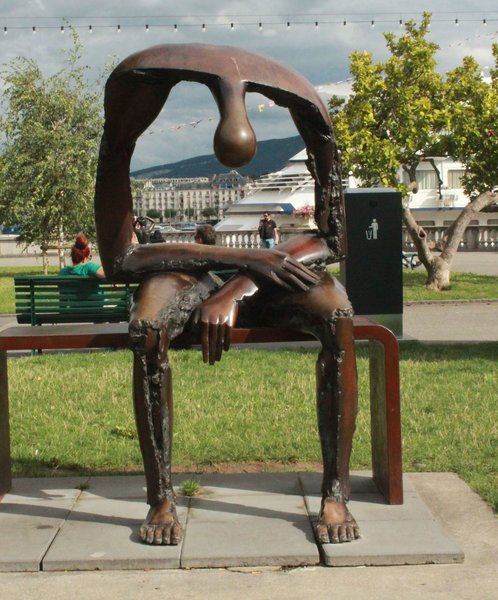
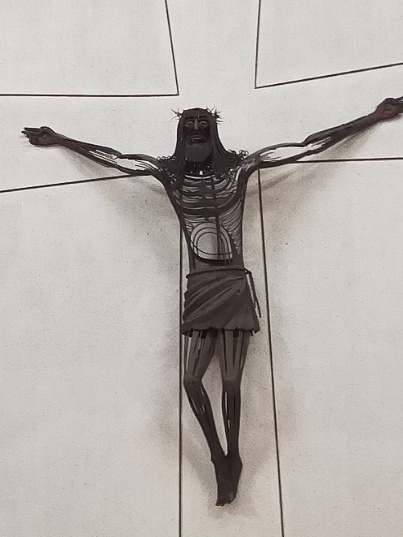
Encounters tend to be generative. And the encounter of two voids that know only Love can quench their thirst for the infinite is surely deeply fruitful. In recent years I have walked a path that has led me from one void to another: from the immense void left by the absence of a life without words yet overflowing with love, to that void of Love which shelters every other void. This path has led me to explore the depths of the human condition, travelling back and forth between our innermost self and our capacity for relationship. More a spiral than a path, it lets a person discover, in the depths of their being, an intrinsic capacity for relationship and, in the richness of their relationships, their deepest humanity. A spiral that, to my surprise, I found converging on a point of encounter, a common space. The iron Christ in the church of El Port de la Selva could well be called The Cross of Everyone. It probably is not, but the void at the centre of the crucified figure suggests it: a crossroads, an open, empty space where humanity can gather.
Who is everyone?
The void of the cross: a space for everyone, with no exclusions of any kind. But who is “everyone”? If this crossroads is truly to be a place of encounter, without the slightest hint of exclusion, we should make sure that “everyone” is more than a figure of speech. In Catalan, the word tothom (everyone) certainly aspires to be inclusive: it refers to all people, men or women, anyone at all, wherever they come from, whatever they think, whoever they are… But, as we know, saying is one thing and doing is another. We often use “everyone” to mean a particular group, which is, in a way, a contradiction in terms. In class we say: tomorrow everyone must hand in their work — an “everyone” that applies only to the students. In church we say: next Sunday everyone is invited to the celebration… — an “everyone” that most likely carries an unspoken horizon reaching no further than the parishioners. There are countless examples where, consciously or not, “everyone” contains a circle: as wide as you like, but never fully universal.
Those of us who are Christians may ask: and for Jesus, who is “everyone”? The Gospel does not deceive. Gleaning a little here and there, we can easily form a clear enough picture.
We human beings tend to classify. We do it with species, with knowledge, with things… and with people too. In a deeply polarised world, people are sorted into the good and the bad. Naturally, we place ourselves among the good and, without realising it, our “everyone” stops at the threshold where the bad live. Often we would rather the bad were not there at all — that they would convert, or at least stop bothering us. The apostles put something similar to Jesus when they wanted to pull the weeds (the darnel) out of the wheat fields. Jesus’ answer is unequivocal: “No, for while you are pulling up the weeds you may uproot the wheat with them. Let both grow together until the harvest” (Mt 13:29). And in case any doubt remained, in another passage Jesus, after telling us to love our enemies, adds: “So that you may be children of your Father in heaven, who makes his sun rise on the good and the bad and sends rain on the just and the unjust” (Mt 5:45). Jesus does not seem keen on too many classifications. His “everyone” leaves no one out. Indeed, on the cross Jesus shows fully that his suffering does not diminish his inclusiveness. He says to one of the two criminals crucified with him at Golgotha: “Truly I tell you: today you will be with me in paradise” (Lk 23:43). As far as we know, he had made no such promise of paradise to anyone in his whole life, not even to his disciples or followers. He makes it to a criminal: a sign that his “everyone”, like his love, knows no limits.
The world we have built causes the impoverishment — always unjust — of many regions of the planet. Their inhabitants are driven to leave for other places, seeking refuge from violence, poverty, the devastation of the natural environment, plunder… This creates great tensions and challenges for coexistence between those born in a place and those who have arrived from elsewhere. Diversity needs dialogue, not labels that classify, stigmatise and breed prejudice. Here too, “everyone” can shrink, wittingly or not, to those who wear the same label. What does Jesus say? Let us look at what one of the first “apprentice Christians”, the apostle Paul, says: “There is no longer Jew or Greek, slave or free, male or female: you are all one in Christ Jesus” (Gal 3:28). And in another letter, Paul says: “Here there is no longer Greek or Jew, circumcised or uncircumcised, barbarian, Scythian, slave or free; there is only Christ, who is all and in all” (Col 3:11). He says this right after writing: “Do not lie to one another, seeing that you have stripped off the old self with its practices and have clothed yourselves with the new self, which is being renewed in the image of its creator and advances towards full knowledge” (Col 3:9-10). It is as if Paul, the apostle of those who are different, were pointing us towards the common space: Jesus, the new man, renewed in the image of his creator — that is, the guardian of the Trinity, a diversity of distinct Persons in absolute Unity. This may be a first step, but not the last, as we shall see.
Facts generally speak louder than words, so it may help to look at a few examples of how Jesus not only preached a limitless “everyone” but lived it day by day. At table: “Later, while he was at table in his house, many tax collectors and other sinners came and sat down with Jesus and his disciples” (Mt 9:10). We know how those comfortably settled in their “everyone” of the righteous reacted. Or at Jacob’s well, when he is thirsty and asks for water: “Give me water […] How is it that you, a Jew, ask me for water — me, a Samaritan?” (Jn 4:9). We know that the woman, besides being a woman and a Samaritan — that is, a foreigner — had a dubious past. Jesus does not preach at her; he asks her for water. A sermon would have placed the two figures in separate circles: the good man and the sinful woman. By asking for water, Jesus builds a bridge to a point of encounter.
There is another passage that has always struck me as especially significant. It is from the Gospel of Matthew: “Where two or three are gathered in my name, I am there among them” (Mt 18:20). Jesus promises his presence — the presence of God — wherever two or three people are gathered in his name. He puts no label on them: he does not say who they must be, what membership card they must carry or what club they must belong to. He simply says two or three: a circle wide enough, an inclusive “everyone”.
Jesus’ ability always to leave room for encounter is striking. In the Gospel of John we find a dialogue between Pilate and Jesus (Jn 18:37-38). Jesus says: “Everyone who belongs to the truth listens to my voice.” Pilate replies: “What is truth?” And Jesus, who had said “I am the way, the truth and the life” (Jn 14:6), does not answer. I believe he is silent neither out of fear nor to conceal his divinity, but to leave the possibility of encounter open. Just as, on the cross, he offers his executioners the chance of one last act of mercy: “After this, Jesus, knowing that all was now finished, said, in order to fulfil the Scripture: I am thirsty” (Jn 19:28). Even in that especially hard moment he leaves a slender opening for love, for encounter, for connection.
I have chosen these passages, but there are many others. Yet there is one, also in the Gospel of John, that dispels any doubt about the universality of Jesus’ “everyone”: “That they may all be one, as you, Father, are in me and I in you” (Jn 17:21). These words belong to the boldest prayer Jesus addresses to the Father, in an unimaginable intimacy, shortly before his Passion and death on the cross begin. It is said to be his last prayer with his disciples. So it seems to be more than a wish: perhaps a testament. Jesus, in the unfathomable depth of his pain, asks — begs — the Father for a point of encounter for everyone. A place where, amid the most genuine diversity, the most radical unity is possible: the unity that is the very life of the Trinity. As we saw, the apostle Paul already presents Jesus to us as the new man, the man-world who gathers everyone in. But can this “all” that Jesus begs of the Father exclude those who do not believe in him? We know the answer must be no; but, for now, let us leave the question open.
Who is on the cross?
Be that as it may, after that prayer Jesus ended up on the cross. And the cross is like a crossroads: sometimes it seems deserted, sometimes it is busy with traffic, and at times we feel utterly alone there. Throughout history the cross has been depicted in every possible way. In the first and second centuries the figure of Christ did not appear on it; later he began to be shown without signs of suffering, majestic rather than in pain. Only in the thirteenth and fourteenth centuries do crosses with a suffering Jesus begin to appear. Today, apart from the wayside crosses (creus de terme) still found in many towns, we have to look for the cross inside churches, chapels, convents and shrines. There we find every kind. Sometimes the cross is bare, with no human figure; sometimes the artist plays with its outline to cast a shadow that looks like a figure. Works of modern or contemporary art, and of the purest classicism. A diversity of inspirations, a diversity of paths, all leading to the same crossroads. In fact, the wayside cross usually stands at the entrance to a town, where the streets begin and the roads meet: a point of encounter of diversity, of locals and outsiders alike.
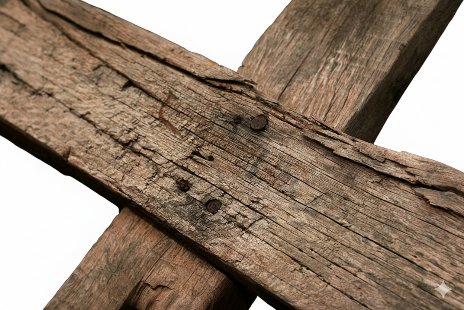
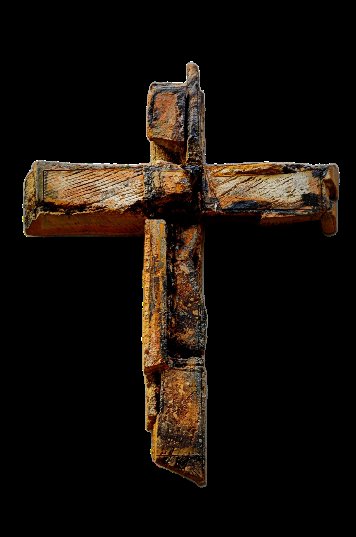
There are crosses of wood, some sturdy, others fragile and porous. There are crosses of rough stone and of fine marble. There are crosses of iron, plain and humble, and of precious metals and stones, reminders of life’s contrasts. And when there is a figure on the cross, it is a man’s: Jesus of Nazareth. A carpenter’s apprentice, still young, tried without justice, condemned without a crime and executed by the cruellest and most humiliating of punishments. On the cross hangs a man who has failed. A point of encounter for the many failures that men and women experience in the course of their lives: pain, loss, illness, suffering, anguish, loneliness, injustice, incomprehension, disorientation, discouragement, meaninglessness… death (the cross of everyone). A point of encounter, too, for the many different ways of looking at this disfigured figure. For some he is merely a failed carpenter; for others, a half-mad prophet; for others, a good man who fell victim to the powers of his day; and for many, the Son of God.
For Christians down the centuries, on the cross hangs God made flesh, in agony. And at the foot of the cross stands a woman, a housewife: Mary, his mother. And another woman, Mary Magdalene. The Virgin Mother and the woman with a troubled past, together at the point of encounter of the cross. A circle without limits. A point of encounter for all the mothers (and fathers) throughout history who have lost a son or a daughter — a loss that always seems out of place, out of time, and that all too often comes through injustice, hunger, violence or war. A man and a woman, a son and a mother, two hearts wrung by extreme suffering. A point of encounter for all the suffering of humanity. And Mary Magdalene. And the soldiers, and a few onlookers. For some, justice had been done; for others, an injustice committed. For Jesus’ followers, it was a scandal of enormous proportions: God, dead on a cross, at a crossroads that threatened to become a diaspora instead of a point of encounter. Yes, this is what was on the cross. But not everything can be so obvious, so simple… there is much more.
The cry
Yes, there must be something more. Whatever we believe, if we get past the stumbling block of prejudice, we may sense that there, on that cross of everyone, lies a mystery, something that escapes us. Being Christian does not spare us the mystery; faith gives us hope — we believe that Jesus conquered death and that Love is always stronger than death. Even so, the cross remains the centre of Christian faith and culture. In his first letter to the Christians of Corinth, Saint Paul writes: “When I was with you, I decided to know nothing among you except Jesus Christ, and him crucified” (1 Cor 2:2). Those hours at Golgotha hold a secret of unfathomable depth. It hardly seems insignificant that all four evangelists record that Jesus did not die alone: “And with him they crucified two bandits, one on his right and one on his left” (Mk 15:27). Besides Mary, Mary Magdalene, John and a few companions who could be counted among his supporters, and the soldiers who were there on duty, two wrongdoers were executed with Jesus. At the hour of his death, Jesus hung between two men who could hardly have been model citizens to end up that way. The message of the scene seems clear: Jesus also died for those two. In fact, he died for everyone — the real “everyone”, the one that excludes no one. As Saint Paul tells the Corinthians in his second letter: “And he died for all” (2 Cor 5:15).
That is, Jesus dies for everyone and, what is more, before dying he had begged the Father “that they may all be one”. How can this be, when there are people who do not believe Jesus was God? People who believe in nothing transcendent. People who believe in other gods. Chiara Lubich, founder of the Focolare Movement and recipient of the charism of unity, places the heart of the charism she received in the mystery hidden in that cross of everyone. The unity of the human family is the answer to Jesus’ plea “that they may all be one”, and Jesus on the cross is its key. But Chiara Lubich focuses on one utterly singular moment of Jesus’ suffering — the one that, for her, is the summit of all he endured: his abandonment. From a perspective that is probably short-sighted, it might seem there were many other ways to redeem humanity, to show the world the greatness and power of God. But no: his majesty lay in experiencing nothingness. The evangelist Mark says: “At three o’clock Jesus cried out with a loud voice, ‘Eloi, Eloi, lema sabachthani?’, which means, ‘My God, my God, why have you forsaken me?’” (Mk 15:34). This cry, I firmly believe, is the intersection of the cross of everyone, where Jesus’ dream “that they may all be one” becomes possible: the only place where “everyone” has no limits. The only place where everyone can meet, the only place where universal fraternity can be built, woven together.
I do not mean to do theology, cheap or expensive, because I do not know how. I simply gather and share an experience, a spiritual path, guided and inspired by the Ideal of the charism of unity: to walk in a way that makes Jesus’ plea “that they may all be one” possible. A plea in which “all” is an “everyone” without limits. Otherwise, Jesus’ sacrifice on the cross would have been in vain. Behind that cry, I believe, there is an intersection, a point, an instant, an infinity, an unfathomable mystery. It is perhaps only an instant, a moment in which Jesus feels abandoned by God. Unimaginable pain. A moment when Jesus is only a man — the only moment in his life when he was only a man. The most important moment of his whole life, the summit of redemption. By “ceasing” to be God, Jesus opens a point of encounter: our shared humanity, his and ours. Jesus, who is part of the Trinity, opens in that moment a wound through which everyone, in some incomprehensible way, comes to share in this model of coexistence that allows “that we may all be one”. As the moment of Jesus’ greatest suffering, it is also the moment when the measure of his love becomes limitless, unconditional. The open space is a space of love without limits. And here the words Jesus spoke to his disciples at the Last Supper, after washing their feet, take on their full meaning: “I give you a new commandment, that you love one another. Just as I have loved you” (Jn 13:34). A sentence that contains a momentous adverb: as. The measure of love lies in that “as”. Jesus went so far as to lose everything as a man and, in a certain sense, to “lose” his divinity too, in the moment he felt abandoned by the Father. Only in this way can the circle of “everyone” have no limits. Perhaps that is why this commandment of Jesus lives on through history in what is known as the “golden rule”: “Treat others as you would like to be treated.” A principle accepted by almost every religion, and by people with no religious affiliation at all. A model of coexistence that does not stop at beliefs, that attaches no labels of any kind, that answers to the “everyone” at the centre of the cross.
Humanity
We Christians would speak of “divine humanity”, because Jesus has redeemed us, and this has given us the dignity of children of one Father — children of God, “divinised” in some way. But there is life beyond Christianity. There are people who believe neither in Jesus nor in his redemption: are they excluded from that “that they may all be one”? Did Jesus live and suffer only for a few? We know he did not. The evangelist Matthew says: “When Jesus heard that John had been arrested, he withdrew to Galilee; but he left Nazareth and went to live in Capernaum, by the lake, in the territory of Zebulun and Naphtali” (Mt 4:12-13). The lands of Zebulun and Naphtali were pagan territory, known for depravity, corruption and dissolute living. Jesus did not go there to visit, or in passing. Matthew says: “he went to live”. There is too much evidence to exclude anyone from this space of encounter that Jesus opened at the intersection of the cross.
I am convinced that in that instant of Jesus’ naked humanity — a humanity that is also ours — lies the possibility (perhaps the only one) of finding a point of encounter without limits. A space of relationships free of labels, of boundless encounter, where we can walk together, sharing what unites us most deeply: the human condition. A condition that Jesus, too, came to inhabit exclusively — nothing but human — if only for a moment, thereby opening the door to that boundless point of encounter. For Jesus did not come to label, but to unite while respecting diversity. We will not meet in any of our affiliations, which will always be limited, closed circles, however wide they claim to be. But we can meet in the one label we all share: that of being human. And what does it mean to meet in our naked humanity?
The depths of the human condition are perhaps unfathomable. So I will only touch briefly on a few traits of our humanity which, I believe, foster encounter among us and, very likely, with God too. Because we are relational beings by nature, everything within us is oriented towards relationship, and we become aware that only through relationships can we discover in depth the humanity we share. Some of these elements, which I consider fundamental, are:
Walking open to the spiritual dimension that dwells within us. Cultivating our inner life, listening to our conscience, the capacity for discernment that awaits the ethical response springing from within. Spirituality opens us to encounter, to the search for fraternal relationship.
Dialogue with ourselves makes us aware of our limitations, of those of others and of our surroundings. This awareness gives us the humility to know that encounter can only enrich us.
Encounter is mutually enriching, and this opens the door to gratitude and to the trust that only together can we hope to find meaning in what we live, in what happens around us and in what happens to us.
Dignity is intrinsic to the human condition and common to all. Meeting side by side, in a common, shared space, makes us more aware of the inalienable dignity of every person, beyond even the deepest differences.
Equal dignity moves us to deepen our empathy, a capacity of human nature that makes us better, heals us, improves the world and binds us to one another.
We human beings carry within us a fundamental tool for overcoming the difficulties of life and of relationships, the obstacles of conflict and division: patience, the virtue of the strong.
As relational beings, we are inevitably endowed with the capacity for dialogue, conversation and communication. A dialogue that follows the Trinitarian model is one that bears fruit and transforms.
We are made in the image and likeness of God; that is why we are relationship = Trinity. Relationships steeped in love, because “Whoever does not love does not know God, for God is love” (1 Jn 4:8). Without love, life together would be hell; that is why we humans share the capacity to love, to love one another.
These few elements alone — partial and limited as they are, yet shared by all human beings — would be enough to discover the central point of the cross. That point of encounter where the circle is infinite. That place which is neither vertical nor horizontal, but common. A space that is human because it is divine, and divine because it is human. A place where each person can become more fully who they are: the Muslim can discover the depth of their faith, the Christian can become more and better a Christian, the agnostic can explore the sense of mystery, the person committed to solidarity can broaden their generosity, the one who fights for equality and justice can find still more meaning in that struggle… Labels do not disappear; they are placed at the service of the human condition, which allows an “everyone” without exclusions to enter through that doorless wound at the centre of the cross, to meet and to walk through life together.
The house of everyone
It is possible to meet in the house without roof or walls that Jesus’ cry has built for everyone. A house without limits, founded on that instant when, on the cross, there is only humanity. With that cry, Jesus closes the abyss between the human and the divine, raising the human condition to a “divinised” state in which encounter is possible for everyone. Because we are all human: man or woman, from here or from elsewhere, whatever we think, believe, do or fail to do. If God is Love, he is also freedom, because love is always free. That is why the house of everyone has no walls and no roof; there are no conditions for entering or leaving. It is a unique point of encounter, set in the very heart of God. Whether we are aware of it or not is secondary; whether we believe it or not is secondary. What matters is that, in that place, the human condition alone makes us equal and different. It is the ideal place to exercise our inalienable dignity and our freedom to seek the meaning of life, to explore the mysteries that transcend us, to face our fears, uncertainties and doubts. A welcoming house to return to again and again, because it feels good to be there, because simply by being there we have already reached harbour, however different the paths that brought us.
Any other house with walls and a roof, any limited circle, is not Jesus’ house. Only the place of a limitless “everyone” is the space where we can breathe the air of the Trinity, perhaps without knowing it. An air that draws us closer to one another while keeping our uniqueness intact. An air that spurs us to follow different paths, each our own, to arrive, perhaps, at the same place: the house of everyone. Living this deeply human experience lets us breathe the air of the divine, which cannot be seen, only sensed. Whether or not we know where it comes from, whether we believe it comes from above or from below, is not, I sincerely believe, what matters. Breathing it, though, is essential, because if we do not, we die. Perhaps not physically, but our humanity dies in its deepest expression: spiritual openness to the unknown.
Drawing from the waters of our deepest human condition is, of course, a personal experience. Each of us must do it for ourselves, and in sincere, honest dialogue with our conscience we will keep finding the ethical answers that guide and give meaning to our lives, to what we do and what we leave undone, to what happens around us and what happens to us. But it does not stay locked inside each of us, because knowing the depth of what we are as human persons inevitably draws us towards encounter, since we are relational beings by nature. And this innate capacity to dialogue, to create new relationships, to seek spaces of cooperation and collaboration, has undeniable social consequences. Good coexistence in a plural, diverse society depends on it to a great extent. Without the cultivation of this essential dimension of the person, coexistence languishes in a dance of closed circles, each trying to draw the others into its own. Imposition, manipulation and deceit; the use of force — of weapons, of interests, of money. Crude exploitation of emotions and feelings; unacceptable blackmail; imbalances that wound or kill. Anything goes in trying to widen my circle, which will always be limited and can only survive by confronting the other circles. Power struggles, playground brawls. All this weakens coexistence and often damages it; it causes suffering, injustice, inequality… none of which has any place in the house of everyone, without roof or walls, because there is room there only for an “everyone” without limits.
In the house of everyone, the human condition is the web that shelters suffering, limitations, finitude, losses, voids… everything inherent in our humanity. A web of relationships woven from the love and pain of each person. A multitude of encounters that recall the pain and love of the cross of everyone, that breathe out the life of the Trinity. Whether we are aware of it or not does not matter. Some will give it one label, others another, but in the end the only label that counts for living is the human condition we share — with Jesus, too. Let us not forget that the circle has no edge; it is infinite. We Christians believe that Jesus, after dying on the cross, rose again on the third day. But we sometimes forget who found the empty tomb: “After the sabbath, as the first day of the week was dawning, Mary Magdalene and the other Mary went to see the tomb” (Mt 28:1). God chooses two women, one of them with a far from spotless past, to discover and proclaim the greatest event in history. That empty tomb is perhaps also the space at the centre of the cross that Jesus’ terrible cry opened up, so that the cross could be neither mine nor yours, but everyone’s. A house for everyone, without exclusions.
If Jesus “stripped himself” of his divine condition, can we not “strip ourselves” of the labels we have taken on, so as to meet everyone? Is this limitless encounter not needed in family life, in the neighbourhood, at work, in society…? Is it not a way of breathing the air of Trinitarian life?
Pope Francis said: “Love like a father, let yourself be loved like a child, and spread love throughout the world. This is the ‘mystery’ of the Trinity; the rest is decoration.” To breathe love, which is the very life of God and which embraces the human condition we share, with Jesus too. To dwell in the space of unlimited, unconditional love that Jesus opened at the very centre of the cross with his desperate cry of abandonment. There is no need to check who is aware of it and who is not, who believes it and who does not. What matters is that each of us does everything within our reach so that the circle has no limits and everyone, truly, can share in this point of encounter of humanity. Pope Leo XIV, in his second general audience on 28 May 2025, said: “Before we are believers, we are called to be human.” His first encyclical, dated 15 May 2026, is entitled Magnifica humanitas. There, where we are simply human, with no added label, lies the point of encounter with Jesus and with every man and woman — with all of humanity, without exclusions.
Perhaps in this point of encounter of the cross of everyone, where the human and the divine mingle and blur, lies the essence of Chiara Lubich’s charism of unity. Fabio Ciardi ends his short book Viaggiando il Paradiso1 with this paragraph:
“The first and the last word with which the text of Paradise ’49 begins and ends, respectively — as I mentioned at the outset — seem to me deeply telling of the arc of this extraordinary journey. The first, which marks the start of the journey, is ‘Abbà, Father’: we are in the bosom of the Father, in Paradise. The last, which marks its end, is ‘man’, referring to man’s fullness, which is Christ: ‘Jesus is Love because he is God. But love to overflowing was lived by Jesus Forsaken, who appears only man.’ We are on earth with all of Paradise within. Earth in heaven, heaven on earth. The Paradise that continues among us today…”
And perhaps it is this “only” that allows the immensity of the charism of unity to reach the very marrow of every human being, until “all may be one”.
Fabio Ciardi, Viaggiando il Paradiso, Rome, Città Nuova Editrice, 2019, pp. 63–64. ↩