In my line of work, a question that comes up for me often is how to be with suffering. On a daily basis, I sit with people who suffer. I notice that a big part of it is not about what I do, but about how I show up and how I am present. Because Christianity is a compass for my life, I decided to look at what the life of Christ teaches me about being with suffering whilst remaining true to insights from psychotherapy. This is what I’ve found.
There are a lot of examples throughout the Gospels of how Jesus was present to those who suffered: the poor (Matthew 14:13-21), the physically (Matthew 14:14) and mentally ill (Mark 1:23-27), the socially excluded (Luke 5:12-16), or foreigners (John 4). The most important teaching on suffering I’ve found is in Jesus’ death. Jesus Crucified and Forsaken (Matthew 27:46; Mark 15:34) is the revelation that God not only became human and was close to those who suffered, but himself became pain and suffering: physical, emotional, social, spiritual.
When I look at Jesus on the cross, I’m aware that I’m in the presence of a mystery. More often than not, I don’t understand it. When I look long enough though, I begin to comprehend that Jesus’ forsakenness has a deep message. When God became human, he chose to be like one of us and would experience our darkest moments and our darkest pain. What many of us have to endure, he had to endure too. The mystery of Jesus’ suffering and death reveals to us God’s identification with unbelievable pain and suffering.
In my room, I have a small print of a painting by Jean-Georges Cornélius (23 January 1880, Strasbourg - 3 June 1963, Ploubazlanec), a French painter, that speaks to me. For me, it is the expression of a mystery that I cannot understand, only grasp in glimpses:
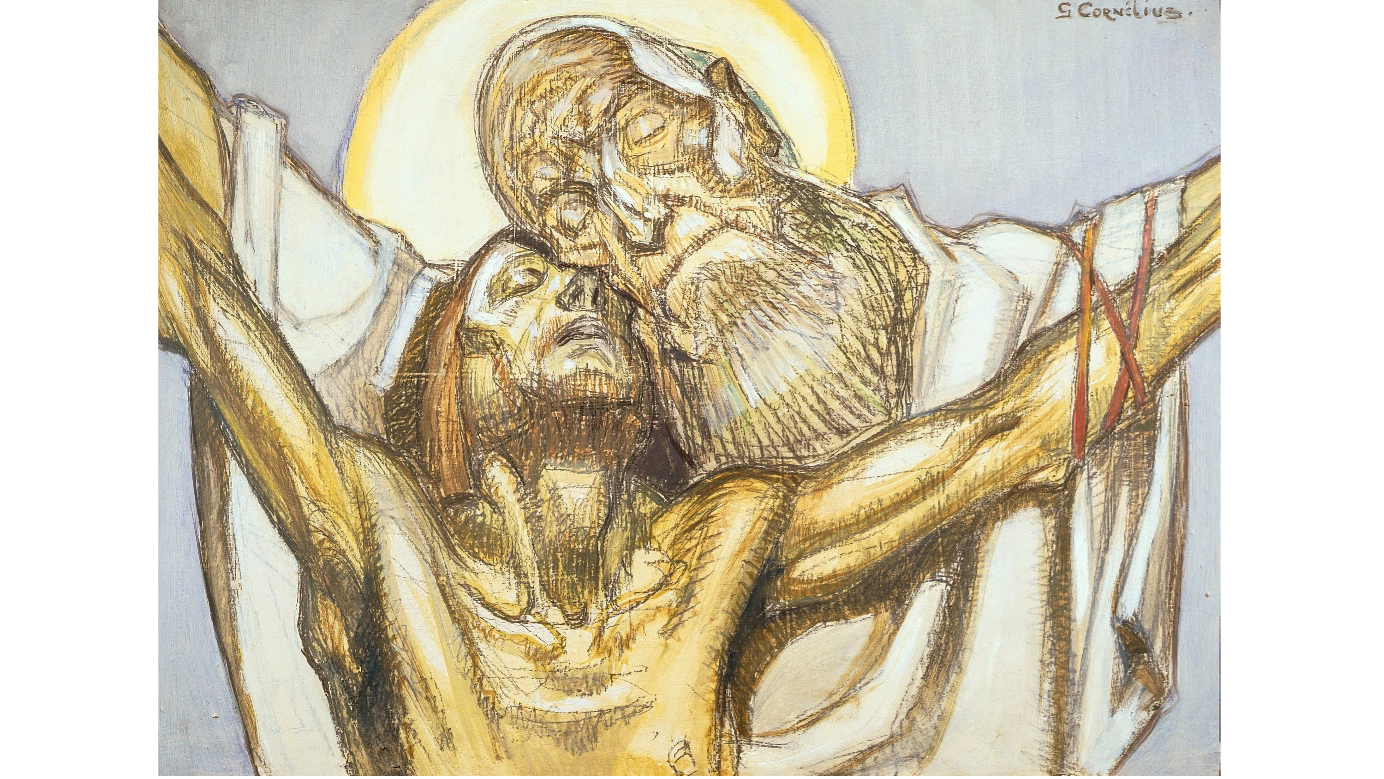 Painting by Jean-Georges Cornélius
The painting speaks about the mystery of the cross, the mystery that God becomes human suffering, rather than doing something to it. It tells us that in Jesus, God reveals to us that even though his love doesn’t protect us from anything, he mysteriously sustains us in all things.
A question that may come up here is: what could that mean for my own life?
Chiara Lubich and bridal mysticism
In search for a response, I found inspiration in Chiara Lubich, one of the great women mystics of the 20th century. Some scholars describe her spirituality as bridal mysticism, a tradition in which the soul relates to God in a deeply intimate way. I want to introduce you to parts of a talk she gave in 1972 and that reflects such bridal mysticism. The talk is colloquial and has the air of a living room conversation.
In this talk, Chiara talks about sound psychological processes when confronted with suffering. In it, she also describes, however, her great spiritual love-story: in every suffering, no matter what, she finds her spouse, the love of her life: Jesus Forsaken. The love she has for him, makes her go towards suffering, rather than run away from it. It’s important to mention that when Chiara talks about going towards suffering, she intends unavoidable suffering. It has always been clear to her that when suffering is avoidable, it is necessary to remove its cause, be it psychological, physical, social, or political – personal or collective.
In one part of the talk, Chiara tells an experience she had when she heard that an incredibly precious piece of art had been damaged by a person who was mentally unwell. She describes that she felt “stunned” at this news, didn’t know what to feel or think. This is what she says:
“So while I felt stunned, I tried to give a name to this suffering. In saying the name, however, I tried to put myself in an attitude of loving this suffering: Jesus Forsaken ‘stunned,’ and I called him by name. I called him by name in the sense that I said, ‘stunned.’ In that moment it seemed that Jesus Forsaken could be summed up in this one word, ‘stunned,’ that this one word explained the reality of Jesus Forsaken, ‘the one who was stunned.’”
Chiara describes how she gave a name to a fact that overwhelmed her. Neuro-physiological research shows that when we do such a thing, giving a name to a painful situation, it calms the area in our brain which triggers us into anxiety, anger or panic (Liebermann et al., 2007). Doing so, pausing and giving it a name, our ability to discern, care, and show compassion comes back online. This makes it possible for us not to run away from pain or suppress it and gives us the capacity for compassion and love.
In her talk, Chiara continues:
“There was another word that had the same effect on me, so I wrote it down here. I had a particular job to do, but it was impossible for me to do it. So I felt blocked, restrained, at a standstill. It was impossible for me to go ahead and this was a suffering. So I loved the suffering, because we must love suffering, and as soon as I started to love it, I understood that his name is ‘blocked,’ one who is blocked. And so I realized that Jesus Forsaken is one who is blocked. In fact, he appeared to me to be only that – a person who is unable to move, blocked.”
Here Chiara describes another painful situation. She refers to feeling “blocked, restrained, at a standstill.” She speaks about “loving the suffering” and goes as far as to say “we must love suffering.” I would like to unpick this for a moment. I imagine “loving suffering” may sound unacceptable. “Loving suffering” can sound even a harmful thing to do as, indeed, it is psychologically healthy to avoid and prevent pain or suffering. We must do everything we can do to heal pain and alleviate suffering. This expression needs clarifying, therefore. Doing some historical research in the archives, I became aware that Chiara has often used the expression “to love suffering,” as a shortcut to “to loving Jesus Forsaken within that suffering.” For example, talking to a group of people in 1995 in Graechen (Switzerland), somebody asked her what to do when the expression “to love pain” appears a frightening concept. Chiara emphasizes in her answer that it is not about loving pain, but about loving Jesus Forsaken, who is present in every person who suffers.
Dialogue with psychology
Understanding better that Chiara’s core message is about loving the person of the crucified Jesus who presents himself within every suffering, I noticed, though, that my curiosity about the expression “to love suffering” remained. I wondered what would happen if I substituted the verb “to love” with related verbs. I did that and looked at what different writers in the field of psychology had to say. I reframed “to love suffering” with “to accept”, “to embrace” or “to give meaning.” This is what I’ve found.
Arnold Beisser, one of the pioneers of Gestalt psychotherapy coined the concept of the “paradoxical theory of change.” Inspired by his own life experience, which meant living almost totally paralyzed from age 24 onwards, he states that growth, change or healing occur organically when we bring undesirable facts of life to awareness and allow what we cannot change, rather than denying it or frantically trying to change it. He famously stated: “Change occurs when one becomes what he is, not when he tries to become what he is not.” (Beisser, 1970, p.77).
Steven Hayes, the founder of Acceptance and Commitment Therapy talks about accepting and embracing difficult circumstances. He writes: “Acceptance, in the sense it is used here, is not nihilistic self-defeat; neither is it tolerating and putting up with your pain … [It is] the active, vital embrace of the moment.” (Hayes, 2005, p. 29).
Viktor Frankl who became famous through his experience in a concentration camp during the second world war, later founded Logotherapy, a psychotherapeutic approach that emphasizes the finding of meaning in one’s life as central to healing. He suggests: “Suffering ceases to be suffering at the moment it finds a meaning.” (Frankl, 1946 [1992], p.84).
In this light, I would describe Chiara’s approach as follows: she doesn’t glance over suffering, she slows down, brings it to her awareness, doesn’t try to change it but embraces it. She is an active agent in the encounter with it. Finally, and possibly the most important step, she gives it meaning: in the undesired fact of life, she sees the face of her spiritual spouse, of Jesus Forsaken. For her, this changes everything. This approach, if it is chosen freely and not imposed, is a wholesome way of being with suffering.
A game of hide and seek
Returning to Chiara Lubich’s talk of 1972, she continues:
“At a certain point, I lived Jesus Forsaken in a moment when I found myself perplexed before a particular situation. I felt the suffering, I began to understand that this suffering had to be loved and I gave it a name. I said: ‘perplexed.’ As I was saying the name, in a certain sense I was calling Jesus because ‘I will manifest myself to the one who loves me.’ And so in loving the suffering, he showed himself to me. I realized that beneath that word, ‘perplexed,’ there was the whole reality of Jesus Forsaken, because in order to describe Jesus Forsaken, it would suffice to say that he was ‘perplexed.’ And then I felt like laughing because it’s as if the soul and Jesus are playing a game of hide and seek. At a certain moment, he peeps out from behind a tree and says, ‘It’s me.’ ‘Oh, you again? It’s always you? You’re perplexed? You’re blocked? You’re…’ all the way down the line… ‘Troubled? You’re a difficulty, impossibility, you’re…?’ And I have the impression that this one word exhausts the whole reality of Jesus Forsaken. It’s as if my spouse dresses himself in a new and different way to present himself to me. So since I see him dressed in a new way, but I realize that, under that clothing, it is always him, ‘perplexed’ or ‘blocked,’ it makes me feel like smiling. And so I smile at him and after the smile, it’s easy to say, ‘I love you.’”
In this last part the sound psychological steps offered by Chiara Lubich, flourish in a spiritual dimension. I appreciate the richness of image when she describes Jesus Forsaken playing hide and seek with her; her willingness to let herself be surprised by him in every moment, welcoming him with the love of a bride welcoming her spouse. With this part, I recognize how Chiara’s way of being with suffering inserts her in a line of mystical tradition that sees the mystery of God as better known by unknowing. In the Hebrew Bible/Old Testament, we read “Truly, you are a God who hides himself, O God of Israel, the Saviour” (Isa 45:15).
References
- Beisser, A. (1970) ‘The paradoxical theory of change’, Gestalt Therapy Now, pp.77-80.
- Frankl, V. (1946 [1992]) Man’s Search for Meaning. Beacon Press: Boston.
- Hayes, S. (2005) Get Out of Your Mind and Into Your Life: The New Acceptance and Commitment Therapy. New Harbinger Publications: Oakland, CA.
- Lieberman et al. (2007) ‘Putting Feelings Into Words: Affect Labeling Disrupts Amygdala Activity in Response to Affective Stimuli’, Psychological Science, 18(5), 421–428.
- Lubich, C. (1972) I vestiti di Gesù Abbandonato. Archive of the Focolare Movement.
- Lubich, C. (1995) Chiara alla Mariapoli-vacanze: Risposte alle domande. Archive of the Focolare Movement.
Nel mio lavoro, una domanda che mi si pone spesso è come stare con la sofferenza. Quotidianamente, mi siedo accanto a persone che soffrono. Noto che gran parte di ciò non riguarda ciò che faccio, ma come mi presento e come sono presente. Poiché il Cristianesimo è una bussola per la mia vita, ho deciso di guardare a ciò che la vita di Cristo mi insegna su come stare con la sofferenza, rimanendo fedele alle intuizioni della psicoterapia. Ecco ciò che ho trovato.
Ci sono molti esempi nei Vangeli di come Gesù fosse presente a coloro che soffrivano: i poveri (Matteo 14,13-21), i malati fisicamente (Matteo 14,14) e mentalmente (Marco 1,23-27), gli esclusi socialmente (Luca 5,12-16), o gli stranieri (Giovanni 4). L’insegnamento più importante sulla sofferenza che ho trovato è nella morte di Gesù. Gesù Crocifisso e Abbandonato (Matteo 27,46; Marco 15,34) è la rivelazione che Dio non solo si è fatto uomo ed è stato vicino a coloro che soffrivano, ma è diventato lui stesso dolore e sofferenza: fisica, emotiva, sociale, spirituale.
Quando guardo Gesù in croce, sono consapevole di trovarmi di fronte a un mistero. Il più delle volte, non lo comprendo. Quando però lo guardo abbastanza a lungo, comincio a capire che l’abbandono di Gesù porta un messaggio profondo. Quando Dio si è fatto uomo, ha scelto di essere come uno di noi e di vivere i nostri momenti più bui e il nostro dolore più intenso. Ciò che molti di noi devono sopportare, anche lui ha dovuto sopportare. Il mistero della sofferenza e della morte di Gesù ci rivela l’identificazione di Dio con un dolore e una sofferenza inimmaginabili.
Nel mio studio ho una piccola riproduzione di un dipinto di Jean-Georges Cornélius (23 gennaio 1880, Strasburgo - 3 giugno 1963, Ploubazlanec), pittore francese, che mi parla nel profondo. Per me, è l’espressione di un mistero che non riesco a comprendere, ma solo a cogliere a tratti:
Dipinto di Jean-Georges Cornélius
Il dipinto parla del mistero della croce, del mistero che Dio diventa la sofferenza umana, invece di fare qualcosa ad essa. Ci dice che in Gesù, Dio ci rivela che, sebbene il suo amore non ci protegga da nulla, ci sostiene misteriosamente in tutto.
Una domanda che potrebbe sorgere qui è: cosa potrebbe significare questo per la mia vita?
Chiara Lubich e la mistica sponsale
In cerca di una risposta, ho trovato ispirazione in Chiara Lubich, una delle grandi donne mistiche del XX secolo. Alcuni studiosi descrivono la sua spiritualità come mistica sponsale, una tradizione in cui l’anima si relaziona a Dio in modo profondamente intimo. Voglio presentarvi alcuni brani di un discorso che tenne nel 1972 e che riflette tale mistica sponsale. Il tono è colloquiale e ha l’atmosfera di una conversazione in salotto.
In questo discorso, Chiara parla di sani processi psicologici di fronte alla sofferenza. In esso, però, descrive anche la sua grande storia d’amore spirituale: in ogni sofferenza, qualunque essa sia, trova il suo sposo, l’amore della sua vita: Gesù Abbandonato. L’amore che prova per lui la spinge ad andare verso la sofferenza, piuttosto che fuggirla. È importante sottolineare che quando Chiara parla di andare verso la sofferenza, intende la sofferenza inevitabile. Le è sempre stato chiaro che quando la sofferenza è evitabile, è necessario rimuoverne la causa, sia essa psicologica, fisica, sociale o politica – personale o collettiva.
In una parte del discorso, Chiara racconta un’esperienza che ha vissuto quando ha saputo che un’opera d’arte di inestimabile valore era stata danneggiata da una persona con problemi mentali. Descrive di essersi sentita “stordita” dalla notizia, senza sapere cosa sentire o pensare. Ecco le sue parole:
“Così, mentre mi sentivo stordita, ho cercato di dare un nome a questa sofferenza. Nel pronunciare il nome, però, ho cercato di pormi in un atteggiamento di amare questa sofferenza: Gesù Abbandonato ‘stordito’, e l’ho chiamato per nome. L’ho chiamato per nome nel senso che ho detto: ‘stordito’. In quel momento mi sembrava che Gesù Abbandonato si potesse riassumere in questa sola parola, ‘stordito’, che questa sola parola spiegasse la realtà di Gesù Abbandonato, ‘colui che era stordito’.”
Chiara descrive come ha dato un nome a ciò che la travolgeva. La ricerca neurofisiologica mostra che quando facciamo una cosa del genere, dare un nome a una situazione dolorosa, si calma l’area del cervello che ci spinge all’ansia, alla rabbia o al panico (Liebermann et al., 2007). Facendolo, facendo una pausa e dandogli un nome, la nostra capacità di discernere, prenderci cura e mostrare compassione torna attiva. Questo rende possibile non fuggire dal dolore né sopprimerlo, e ci dà la capacità di compassione e amore.
Nel suo discorso, Chiara continua:
“C’era un’altra parola che aveva lo stesso effetto su di me, quindi l’ho scritta qui. Avevo un lavoro particolare da fare, ma mi era impossibile farlo. Così mi sentivo bloccata, trattenuta, ferma. Mi era impossibile andare avanti e questa era una sofferenza. Così ho amato la sofferenza, perché dobbiamo amare la sofferenza, e non appena ho cominciato ad amarla, ho capito che il suo nome è ‘bloccato’, colui che è bloccato. E così ho capito che Gesù Abbandonato è uno che è bloccato. In realtà, mi apparve solo quello – una persona che non riesce a muoversi, bloccata.”
Qui Chiara descrive un’altra situazione dolorosa. Si riferisce al sentirsi “bloccata, trattenuta, ferma”. Parla di “amare la sofferenza” e arriva a dire “dobbiamo amare la sofferenza”. Vorrei soffermarmi su questo per un momento. Immagino che “amare la sofferenza” possa sembrare inaccettabile. “Amare la sofferenza” può sembrare persino qualcosa di dannoso, poiché è psicologicamente sano evitare e prevenire il dolore e la sofferenza. Dobbiamo fare tutto ciò che possiamo per guarire il dolore e alleviare la sofferenza. Questa espressione ha quindi bisogno di essere chiarita. Facendo alcune ricerche storiche negli archivi, ho notato che Chiara ha spesso usato l’espressione “amare la sofferenza” come abbreviazione di “amare Gesù Abbandonato in quella sofferenza”. Per esempio, parlando a un gruppo di persone nel 1995 a Graechen (Svizzera), qualcuno le chiese cosa fare quando l’espressione “amare il dolore” appare un concetto spaventoso. Chiara sottolinea nella sua risposta che non si tratta di amare il dolore, ma di amare Gesù Abbandonato, presente in ogni persona che soffre.
Dialogo con la psicologia
Comprendendo meglio che il messaggio centrale di Chiara riguarda l’amare la persona del Gesù crocifisso che si presenta in ogni sofferenza, ho notato però che la mia curiosità per l’espressione “amare la sofferenza” rimaneva. Mi sono chiesta cosa sarebbe successo se avessi sostituito il verbo “amare” con verbi correlati. L’ho fatto e ho guardato ciò che diversi autori nel campo della psicologia hanno da dire. Ho riformulato “amare la sofferenza” con “accettare”, “abbracciare” o “dare significato”. Ecco ciò che ho trovato.
Arnold Beisser, uno dei pionieri della psicoterapia della Gestalt, ha coniato il concetto di “teoria paradossale del cambiamento”. Ispirato dalla propria esperienza di vita, che significava vivere quasi completamente paralizzato dall’età di 24 anni in poi, afferma che crescita, cambiamento o guarigione avvengono organicamente quando portiamo alla consapevolezza i fatti indesiderabili della vita e permettiamo ciò che non possiamo cambiare, invece di negarlo o cercare freneticamente di cambiarlo. Ha famosamente affermato: “Il cambiamento avviene quando si diventa ciò che si è, non quando si cerca di diventare ciò che non si è.” (Beisser, 1970, p.77).
Steven Hayes, il fondatore della Terapia dell’Accettazione e dell’Impegno (ACT), parla di accettare e abbracciare le circostanze difficili. Scrive: “L’accettazione, nel senso in cui viene usata qui, non è una resa nichilistica; né è tollerare e sopportare il proprio dolore… [È] l’abbraccio attivo e vitale del momento.” (Hayes, 2005, p. 29).
Viktor Frankl, diventato famoso grazie alla sua esperienza in un campo di concentramento durante la seconda guerra mondiale, fondò successivamente la Logoterapia, un approccio psicoterapeutico che enfatizza la ricerca di significato nella propria vita come centrale per la guarigione. Egli suggerisce: “La sofferenza cessa di essere sofferenza nel momento in cui trova un significato.” (Frankl, 1946 [1992], p.84).
In questa luce, descrivo l’approccio di Chiara come segue: non sorvola sulla sofferenza, rallenta, la porta alla consapevolezza, non cerca di cambiarla ma la abbraccia. È un agente attivo nell’incontro con essa. Infine, e forse il passo più importante, le dà un significato: nel fatto indesiderato della vita, vede il volto del suo sposo spirituale, di Gesù Abbandonato. Per lei, questo cambia tutto. Questo approccio, se scelto liberamente e non imposto, è un modo sano di stare con la sofferenza.
Un gioco di nascondino
Tornando al discorso di Chiara Lubich del 1972, lei continua:
“A un certo punto, ho vissuto Gesù Abbandonato in un momento in cui mi sono trovata perplessa davanti a una situazione particolare. Ho sentito la sofferenza, ho cominciato a capire che questa sofferenza doveva essere amata e le ho dato un nome. Ho detto: ‘perplessa’. Mentre dicevo il nome, in un certo senso stavo chiamando Gesù perché ‘mi manifesterò a chi mi ama’. E così, amando la sofferenza, lui si è mostrato a me. Ho capito che sotto quella parola, ‘perplessa’, c’era tutta la realtà di Gesù Abbandonato, perché per descrivere Gesù Abbandonato basterebbe dire che era ‘perplesso’. E poi mi è venuto da ridere perché è come se l’anima e Gesù giocassero a nascondino. A un certo momento, lui fa capolino da dietro un albero e dice: ‘Sono io’. ‘Oh, ancora tu? Sei sempre tu? Sei perplesso? Sei bloccato? Sei…’ e così via… ‘Turbato? Sei una difficoltà, un’impossibilità, sei…?’ E ho l’impressione che questa sola parola esaurisca tutta la realtà di Gesù Abbandonato. È come se il mio sposo si vestisse in modo nuovo e diverso per presentarsi a me. Così poiché lo vedo vestito in modo nuovo, ma mi rendo conto che, sotto quei vestiti, è sempre lui, ‘perplesso’ o ‘bloccato’, mi viene da sorridere. E così gli sorrido e dopo il sorriso, è facile dire: ‘Ti amo’.”
In quest’ultima parte, i sani passi psicologici offerti da Chiara Lubich fioriscono in una dimensione spirituale. Apprezzo la ricchezza dell’immagine quando descrive Gesù Abbandonato che gioca a nascondino con lei; la sua disponibilità a lasciarsi sorprendere da lui in ogni momento, accogliendolo con l’amore di una sposa che accoglie il suo sposo. Con questa parte, riconosco come il modo di Chiara di stare con la sofferenza la inserisca in una linea di tradizione mistica che vede il mistero di Dio come meglio conosciuto attraverso il non-sapere. Nella Bibbia ebraica/Antico Testamento, leggiamo: “Veramente tu sei un Dio che si nasconde, Dio di Israele, Salvatore” (Is 45,15).
Riferimenti
- Beisser, A. (1970) ‘La teoria paradossale del cambiamento’, Gestalt Therapy Now, pp.77-80.
- Frankl, V. (1946 [1992]) Alla ricerca di un significato. Beacon Press: Boston.
- Hayes, S. (2005) Esci dalla tua mente ed entra nella tua vita: La nuova terapia dell’accettazione e dell’impegno. New Harbinger Publications: Oakland, CA.
- Lieberman et al. (2007) ‘Mettere i sentimenti in parole: l’etichettatura affettiva interrompe l’attività dell’amigdala in risposta a stimoli affettivi’, Psychological Science, 18(5), 421–428.
- Lubich, C. (1972) I vestiti di Gesù Abbandonato. Archivio del Movimento dei Focolari.
- Lubich, C. (1995) Chiara alla Mariapoli-vacanze: Risposte alle domande. Archivio del Movimento dei Focolari.
En mi campo de trabajo, una pregunta que se me plantea a menudo es cómo estar con el sufrimiento. A diario, me siento junto a personas que sufren. Noto que gran parte de ello no tiene que ver con lo que hago, sino con cómo me presento y cómo estoy presente. Dado que el Cristianismo es una brújula para mi vida, decidí examinar qué me enseña la vida de Cristo sobre cómo estar con el sufrimiento mientras permanezco fiel a las intuiciones de la psicoterapia. Esto es lo que he encontrado.
Hay muchos ejemplos a lo largo de los Evangelios de cómo Jesús estuvo presente a quienes sufrían: los pobres (Mateo 14,13-21), los enfermos físicamente (Mateo 14,14) y mentalmente (Marcos 1,23-27), los excluidos socialmente (Lucas 5,12-16), o los extranjeros (Juan 4). La enseñanza más importante sobre el sufrimiento que he encontrado está en la muerte de Jesús. Jesús Crucificado y Abandonado (Mateo 27,46; Marcos 15,34) es la revelación de que Dios no solo se hizo hombre y estuvo cerca de quienes sufrían, sino que él mismo se convirtió en dolor y sufrimiento: físico, emocional, social, espiritual.
Cuando miro a Jesús en la cruz, soy consciente de estar frente a un misterio. La mayoría de las veces, no lo comprendo. Sin embargo, cuando lo miro el tiempo suficiente, comienzo a comprender que el abandono de Jesús porta un mensaje profundo. Cuando Dios se hizo hombre, eligió ser como uno de nosotros y experimentó nuestros momentos más oscuros y nuestro dolor más intenso. Lo que muchos de nosotros debemos soportar, él también tuvo que soportarlo. El misterio del sufrimiento y la muerte de Jesús nos revela la identificación de Dios con un dolor y un sufrimiento increíbles.
En mi consulta tengo una pequeña reproducción de un cuadro de Jean-Georges Cornélius (23 de enero de 1880, Estrasburgo - 3 de junio de 1963, Ploubazlanec), un pintor francés, que me habla. Para mí, es la expresión de un misterio que no puedo comprender, solo captar en destellos:
Cuadro de Jean-Georges Cornélius
El cuadro habla del misterio de la cruz, del misterio de que Dios se convierte en el sufrimiento humano, en lugar de hacer algo al respecto. Nos dice que en Jesús, Dios nos revela que aunque su amor no nos protege de nada, nos sostiene misteriosamente en todo.
Una pregunta que puede surgir aquí es: ¿qué podría significar eso para mi propia vida?
Chiara Lubich y la mística nupcial
En busca de una respuesta, encontré inspiración en Chiara Lubich, una de las grandes mujeres místicas del siglo XX. Algunos estudiosos describen su espiritualidad como mística nupcial, una tradición en la que el alma se relaciona con Dios de una manera profundamente íntima. Quiero presentarles partes de una charla que dio en 1972 y que refleja dicha mística nupcial. La charla es coloquial y tiene el aire de una conversación en el salón.
En esta charla, Chiara habla de sanos procesos psicológicos cuando se enfrenta al sufrimiento. En ella también describe, sin embargo, su gran historia de amor espiritual: en cada sufrimiento, pase lo que pase, encuentra a su esposo, el amor de su vida: Jesús Abandonado. El amor que siente por él la hace ir hacia el sufrimiento, en lugar de huir de él. Es importante mencionar que cuando Chiara habla de ir hacia el sufrimiento, se refiere al sufrimiento inevitable. Siempre le ha quedado claro que cuando el sufrimiento es evitable, es necesario eliminar su causa, ya sea psicológica, física, social o política, personal o colectiva.
En una parte de la charla, Chiara cuenta una experiencia que tuvo cuando supo que una obra de arte de inestimable valor había sido dañada por una persona con una enfermedad mental. Describe que se sintió «atónita» ante esta noticia, sin saber qué sentir ni qué pensar. Esto es lo que dice:
«Así, mientras me sentía atónita, intenté dar un nombre a ese sufrimiento. Al decir el nombre, sin embargo, intenté ponerme en una actitud de amar ese sufrimiento: Jesús Abandonado “atónito”, y lo llamé por su nombre. Lo llamé por su nombre en el sentido de que dije: “atónito”. En ese momento me pareció que Jesús Abandonado podía resumirse en esta sola palabra, “atónito”, que esta sola palabra explicaba la realidad de Jesús Abandonado, “el que estaba atónito”.»
Chiara describe cómo dio un nombre a algo que la abrumó. La investigación neurofisiológica muestra que cuando hacemos tal cosa —dar un nombre a una situación dolorosa—, se calma el área de nuestro cerebro que nos impulsa hacia la ansiedad, la ira o el pánico (Liebermann et al., 2007). Al hacerlo, al detenernos y darle un nombre, nuestra capacidad de discernir, cuidar y mostrar compasión vuelve a estar activa. Esto hace posible no huir del dolor ni suprimirlo, y nos da la capacidad de compasión y amor.
En su charla, Chiara continúa:
«Había otra palabra que tuvo el mismo efecto en mí, así que la anoté aquí. Tenía un trabajo particular que hacer, pero me era imposible hacerlo. Así que me sentí bloqueada, retenida, paralizada. Me era imposible seguir adelante y esto era un sufrimiento. Entonces amé el sufrimiento, porque debemos amar el sufrimiento, y tan pronto como empecé a amarlo, comprendí que su nombre es “bloqueado”, uno que está bloqueado. Y así me di cuenta de que Jesús Abandonado es uno que está bloqueado. De hecho, me pareció ser solo eso: una persona que no puede moverse, bloqueada.»
Aquí Chiara describe otra situación dolorosa. Se refiere a sentirse «bloqueada, retenida, paralizada». Habla de «amar el sufrimiento» y llega a decir «debemos amar el sufrimiento». Quisiera profundizar en esto un momento. Imagino que «amar el sufrimiento» puede sonar inaceptable. «Amar el sufrimiento» puede sonar incluso algo dañino, ya que, de hecho, es psicológicamente sano evitar y prevenir el dolor o el sufrimiento. Debemos hacer todo lo posible para sanar el dolor y aliviar el sufrimiento. Por ello, esta expresión necesita aclararse. Investigando un poco en los archivos históricos, me di cuenta de que Chiara ha utilizado a menudo la expresión «amar el sufrimiento» como atajo de «amar a Jesús Abandonado dentro de ese sufrimiento». Por ejemplo, al hablar con un grupo de personas en 1995 en Graechen (Suiza), alguien le preguntó qué hacer cuando la expresión «amar el dolor» parece un concepto aterrador. Chiara subraya en su respuesta que no se trata de amar el dolor, sino de amar a Jesús Abandonado, que está presente en toda persona que sufre.
Diálogo con la psicología
Comprendiendo mejor que el mensaje central de Chiara trata de amar a la persona de Jesús crucificado que se presenta en cada sufrimiento, noté, sin embargo, que mi curiosidad por la expresión «amar el sufrimiento» seguía presente. Me pregunté qué pasaría si sustituyera el verbo «amar» por verbos relacionados. Lo hice y examiné lo que diferentes autores del campo de la psicología tenían que decir. Reformulé «amar el sufrimiento» con «aceptar», «abrazar» o «dar sentido». Esto es lo que encontré.
Arnold Beisser, uno de los pioneros de la psicoterapia Gestalt, acuñó el concepto de la «teoría paradójica del cambio». Inspirado por su propia experiencia de vida —que implicó vivir casi totalmente paralizado desde los 24 años en adelante—, afirma que el crecimiento, el cambio o la sanación se producen orgánicamente cuando llevamos hechos indeseables de la vida a la conciencia y permitimos lo que no podemos cambiar, en lugar de negarlo o intentar cambiarlo frenéticamente. Afirmó célebremente: «El cambio ocurre cuando uno se convierte en lo que es, no cuando intenta convertirse en lo que no es.» (Beisser, 1970, p.77).
Steven Hayes, el fundador de la Terapia de Aceptación y Compromiso, habla de aceptar y abrazar las circunstancias difíciles. Escribe: «La aceptación, en el sentido en que se usa aquí, no es una derrota nihilista; tampoco es tolerar y aguantar tu dolor… [Es] el abrazo activo y vital del momento.» (Hayes, 2005, p. 29).
Viktor Frankl, quien se hizo famoso a través de su experiencia en un campo de concentración durante la Segunda Guerra Mundial, fundó posteriormente la Logoterapia, un enfoque psicoterapéutico que enfatiza la búsqueda de sentido en la propia vida como elemento central de la sanación. Sugiere: «El sufrimiento deja de ser sufrimiento en el momento en que encuentra un sentido.» (Frankl, 1946 [1992], p.84).
A la luz de esto, describiría el enfoque de Chiara de la siguiente manera: no pasa por alto el sufrimiento, se detiene, lo lleva a su conciencia, no intenta cambiarlo sino que lo abraza. Es un agente activo en el encuentro con él. Finalmente, y posiblemente el paso más importante, le da sentido: en el hecho no deseado de la vida, ve el rostro de su esposo espiritual, de Jesús Abandonado. Para ella, esto lo cambia todo. Este enfoque, si se elige libremente y no se impone, es una manera saludable de estar con el sufrimiento.
Un juego del escondite
Volviendo a la charla de Chiara Lubich de 1972, ella continúa:
«En cierto momento, viví a Jesús Abandonado en un instante en que me encontré perpleja ante una situación particular. Sentí el sufrimiento, empecé a entender que ese sufrimiento debía ser amado y le di un nombre. Dije: “perpleja”. Al decir el nombre, en cierto sentido estaba llamando a Jesús porque “me manifestaré al que me ame”. Y así, al amar el sufrimiento, él se me manifestó. Me di cuenta de que debajo de esa palabra, “perpleja”, estaba toda la realidad de Jesús Abandonado, porque para describir a Jesús Abandonado bastaría con decir que estaba “perplejo”. Y entonces sentí ganas de reír, porque es como si el alma y Jesús jugasen al escondite. En cierto momento, él asoma desde detrás de un árbol y dice: “¡Soy yo!”. “¿Otra vez tú? ¿Siempre eres tú? ¿Estás perplejo? ¿Estás bloqueado? ¿Estás…?” y así sucesivamente… “¿Turbado? ¿Eres una dificultad, imposibilidad, eres…?” Y tengo la impresión de que esta sola palabra agota toda la realidad de Jesús Abandonado. Es como si mi esposo se vistiera de manera nueva y diferente para presentarse ante mí. Entonces, como lo veo vestido de manera nueva, pero me doy cuenta de que, bajo esa ropa, siempre es él, “perplejo” o “bloqueado”, me da ganas de sonreír. Y entonces le sonrío y después de la sonrisa, es fácil decir: “Te amo”.»
En esta última parte, los sanos pasos psicológicos que ofrece Chiara Lubich florecen en una dimensión espiritual. Aprecio la riqueza de la imagen cuando describe a Jesús Abandonado jugando al escondite con ella; su disposición a dejarse sorprender por él en cada momento, recibiéndolo con el amor de una esposa que acoge a su esposo. Con esta parte, reconozco cómo la forma de Chiara de estar con el sufrimiento la inserta en una línea de tradición mística que ve el misterio de Dios como algo mejor conocido por el desconocimiento. En la Biblia hebrea/Antiguo Testamento leemos: «Verdaderamente tú eres un Dios que se oculta, oh Dios de Israel, el Salvador» (Is 45,15).
Referencias
- Beisser, A. (1970) ‘La teoría paradójica del cambio’, Gestalt Therapy Now, pp.77-80.
- Frankl, V. (1946 [1992]) El hombre en busca de sentido. Beacon Press: Boston.
- Hayes, S. (2005) Sal de tu mente y entra en tu vida: La nueva terapia de aceptación y compromiso. New Harbinger Publications: Oakland, CA.
- Lieberman et al. (2007) ‘Poner los sentimientos en palabras: el etiquetado afectivo interrumpe la actividad de la amígdala en respuesta a estímulos afectivos’, Psychological Science, 18(5), 421–428.
- Lubich, C. (1972) I vestiti di Gesù Abbandonato. Archivo del Movimiento de los Focolares.
- Lubich, C. (1995) Chiara alla Mariapoli-vacanze: Risposte alle domande. Archivo del Movimiento de los Focolares.